After a brief hiatus, Geo-RoadTrip is back! Come along as we explore Tucson, AZ, the Tucson Gem & Mineral Show, and other fun stuff in the area:
Friday, February 16, 2024

Sunday, January 23, 2022
East Texas Gem & Mineral Show
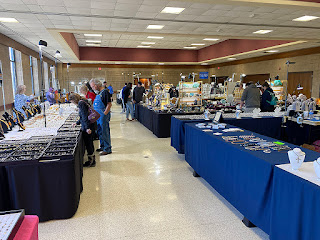
Every year the East Texas Gem & Mineral Society hosts their annual Gemstone & Jewelry Show. Dealers from across Texas and beyond converge on the Tyler Rose Garden Center to sell custom jewelry, unique gem & mineral specimens, rare fossils and other treasures dug from the earth beneath our feet. We've been to a few of the group's functions and was happy to return for this year's show.
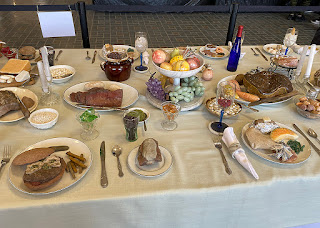
One of the show's best attractions is the Rock Food Table. Take a close look at the picture above. What looks like a delicious spread of fine dining choices are actually all rocks. Most of the pieces are rocks that just happen to be shaped like certain foods but some of them are polished/finished to complete the illusion.
The Rock Food Table is currently owned by a member of the ETGMS but originated by a couple in the Gulf Coast region. A few years back we shot some footage of it for the documentary "RockHounds: The Movie." Here's a clip:
Just for fun, we got some updated video on this visit for our TikTok. Here's a quick look at the current Rock Food Table and maybe you can spot some new dishes on display:
@geologyvideo Rocks that look like food #geology #rocks #gemandmineralshow #science #rockfoodtable #earthscience #fyp ♬ Eat It - "Weird Al" Yankovic

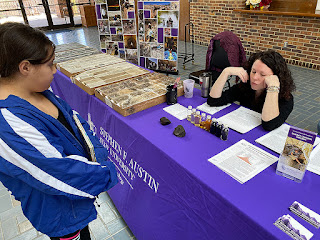
The Geology Department from Stephen F. Austin University was also represented at the show. Professor Bloxson and one of her grad students were there with information about oil deposits in east Texas and the rocks in the area that contain the oil. They had great information for young aspiring geologists and anyone else that might have an interest in the subject.
Wednesday, November 10, 2021
EveryDay Earth in the Classroom

We had the chance to demonstrate EveryDay Earth in a 6th grade classroom recently and it was a hit! Later, we were able to talk to the teacher, Ms. Cook, about here experiences with using EveryDay Earth. Here's a quick video about it:
Sunday, August 8, 2021
Tuesday, July 6, 2021
Latest Shoot: Metamorphic Mayhem
We were in need of metamorphic rock footage for EveryDay Earth so it was time to head back to Colorado. That's a bit of a drive for us, but still the closest source, so we loaded up the camera equipment and road snacks, topped off on gas and off we went.

But nothing worth finding is found easily and, of course, every road trip needs a few unrelated stops just for fun, so we decided to check out the Great Sand Dunes while we were out there. It had been years since we were last here but the dunes were still just and grand and sandy as we remembered.


Check out the ominous storm clouds behind Devin. We were lucky (or unlucky, depending on your point of view) to witness a rain storm pop up at the dunes. With tons of wind accompanying the storm, we got to see the movement of sediment firsthand.

It was a pretty severe storm but, thankfully, it was also short. Tourists who were exploring the tops of the dunes gave us weird looks as they ran past us for shelter while we stayed put trying to get footage. We got some good shots but between the wind, water and sand, we'll probably need to take the camera back in to the shop.


We were eventually able to find several roadside stops where metamorphic rocks were plentiful. We wanted to make sure to get plenty of shots of the "mushiness" (for lack of a better term) that the rocks endured during the extreme amounts of heat and pressure inflicted on them. It helps to be surrounded by the picturesque Colorado landscape while working. These rocks were great but we always want more.


This mine is famous for its marble which has been used all across the country including in the Lincoln Monument and the Tomb of the Unkowns. No mining was happening that day so we could get a nice look at the the mine and could see where chunks of marble were literally being sawed off the walls. It was a pretty productive shoot so far but our luck was about to run out.


Mudslides in Glenwood Canyon had shut down I-70 and cut off our route to Denver so we had to take the long way. And the "long way" involved a convoluted detour across several country dirt roads which were not necessarily created with this high level of traffic in mind. Multiple stops were involved when two lane traffic wasn't possible but, on the bright side, we got to see a part of the country side we wouldn't have. It was an interesting experience to say the least.
All things considered, it was a pretty eventful shoot. There's never a dull moment we you're on the road and the best you can hope for is to come back with some decent footage. You can look forward to seeing more of this part of the country in upcoming Missions of EveryDay Earth!
Wednesday, April 28, 2021
Sunday, March 21, 2021
This Week in Earth Science 03/21/21
Devin takes a look at some of the earth science news fo the past week
Sunday, December 20, 2020
Latest Shoot: 650 Feet Below Kansas

We headed north for our latest shoot, all the way to the Sunflower State. Kansas welcomed us back but it wasn't its flat plains we were looking for, it was underneath them. Strataca, the Underground Salt Museum is a part of a still-working mine owned by the Hutchinson Salt Company and they were nice enough to let us come by and get some footage for EveryDay Earth!

In addition to several tours, the underground museum has tons of exhibits on mining, history and science, all inside the old mine. It only takes 90 seconds to descend the 650 feet into the mine/museum but hours to take it all in. It was great to get shots of the walls of the historic tunnels.

There were also plenty of old mining equipment on display as well as tons and tons of empty dynamite boxes. Apparently "what goes down into the mine, stays in the mine" including artifacts like old food packages, tools and even old footprints from the miners.

As you can probably imagine, the life of a miner was hardly glamorous. The tours provided a good look into their working life including this seat of honor, left untouched for years. Again, "what goes down into the mine, stays in the mine." Due to the nature of the enclosed mine, everything inside it is well-preserved.

And because of this, lots of old films and stored here as well as famous film costumes and props. Our favorite was "Dorothy II" from the movie "Twister" but there were plenty of other stuff from movies like "Batman & Robin," "The Matrix, " and others.
Those were great but we were there for the rocks, of course. We were able to get some great shots that will end up in future Missions of EveryDay Earth, so soon you'll be able to virtually experience Strataca yourself.
Monday, November 2, 2020
Oklahoma Rocks! Online
All four parts of the Teacher's Edition of our documentary "Oklahoma Rocks!" are now on YouTube and you can stream them for free! Here's all four in a YouTube Playlist:
Tuesday, April 14, 2020
EveryDay Earth Transmissions #2
The quarantine continues and EveryDay Earth Headquarters is on lockdown! But don't worry, Devin is broadcasting a steady stream of transmissions. Let's start with some information on coquinas:
Next up is some valuable info on granite. Pay close attention, there's a lot to learn about this valuable rock:
And finally, here's one about the beautiful and mysterious barite rose rocks of Oklahoma:
Saturday, April 4, 2020
EveryDay Earth Transmissions #1
Just like everyone else, we're in lockdown these days due to the global pandemic. But don't worry, while Devin is quarantined at EveryDay Earth Headquarters he can still get messages out. We plan to provide daily (or semi-daily) updated about rocks, minerals, fossils, science or just about anything else. The first transmission is about petrified wood:
Stay tuned for more updates and don't forget to stay home yourself. We'll bring the science to you!
Up next we have some information about Chemical Sedimentary Rocks:
Friday, February 14, 2020
Latest Shoot: Crater of Diamonds
It was time to head east for our latest couple of shoots. It's been awhile since we've shot footage in Arkansas. We covered quartz crystal digging in Mount Ida for "RockHounds: The Movie" and have stopped by the Natural State to get some shots here and there in from time to time. But now was the chance to "dig in" and get something we've had on our "Want List" for awhile now.
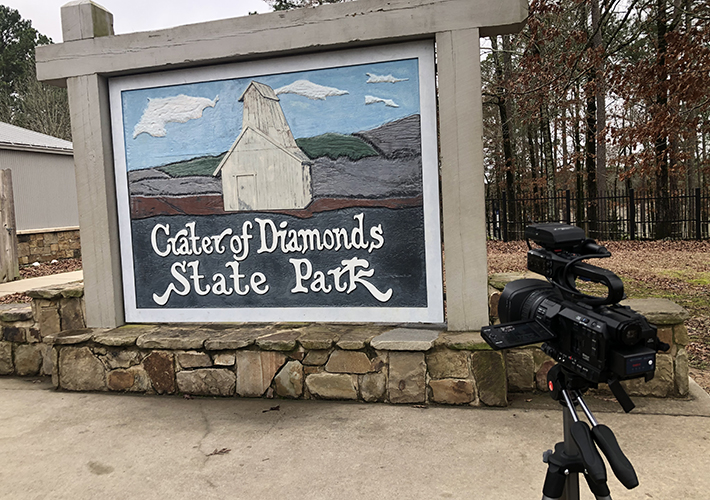
 Crater of Diamonds is one of the most popular state parks in Arkansas. Visitors can dig for actual diamonds and keep what they find. According to the park, they average about 2 diamond finds per day. Not a bad way to spend the afternoon.
 Since many people might not have any diamond mining experience, the park offers demonstrations. Park Interpreter Waymon Cox not only gave us a great interview, he let us shoot footage of him doing one of the demos. The process is easy enough that first time visitors should be able to get it fairly quickly and then get on with the business of digging for diamonds.
 We also interviewed park regular Dave Rhodes about his experiences digging. Over four years of digging, he's found 33 diamonds although he said it took him about nine months to find his first one. He gave us some great tips for digging and took us through the process.
 Even though we didn't find any diamonds that day, Dave brought some of the specimens he had found earlier at the park. So luckily we didn't have to leave without actual diamond footage.
We got a ton of great shots out there so be on the lookout for it in upcoming EveryDay Earth missions!


We got a ton of great shots out there so be on the lookout for it in upcoming EveryDay Earth missions!
Wednesday, February 5, 2020
Latest Shoot: Checking Out Some Rocks at the Library
It takes a lot of footage to make a project like EveryDay Earth. Like all our projects, the kind of shots we typically need are of rocks. We get plenty of footage in the field but since there's no such things as "too many rocks," we're always trying to get more.
Luckily our friends at the Oklahoma Mineral and Gem Society were kind enough to loan us some of their best specimens to shoot. A few days before they had just taken down a display at the Metropolitan Library in downtown Oklahoma City so the timing was prefect.
We needed a space to set up and our friends at another library, the Piedmont Library, let us use some of their space (and show off some rocks). Here's what the setup looks like...

...to get a shot of native sulfur that looks like this:

We spent several hours shooting and had access to some great specimens. There were even several that were so big we couldn't fit them in the light box. That didn't stop us from getting footage of them though.

All in all, it was a very productive day and we'd like to thank everyone who helped out. Be on the lookout for the great shots we got in EveryDay Earth!
Luckily our friends at the Oklahoma Mineral and Gem Society were kind enough to loan us some of their best specimens to shoot. A few days before they had just taken down a display at the Metropolitan Library in downtown Oklahoma City so the timing was prefect.
We needed a space to set up and our friends at another library, the Piedmont Library, let us use some of their space (and show off some rocks). Here's what the setup looks like...

...to get a shot of native sulfur that looks like this:

We spent several hours shooting and had access to some great specimens. There were even several that were so big we couldn't fit them in the light box. That didn't stop us from getting footage of them though.

All in all, it was a very productive day and we'd like to thank everyone who helped out. Be on the lookout for the great shots we got in EveryDay Earth!
Sunday, January 5, 2020
EveryDay Earth Clips
We have a few new clips from EveryDay Earth available. If you haven't checked out EveryDay Earth yet, it's a free interactive video curriculum supplement for teachers. You can follow Devin and the EveryDay Earth Corps on adventures and choose which data gets collected in different locations along the adventure.
Throughout the lessons, STEM concepts are explored in short videos that students can click on as they progress. Here's a quick overview of precipitation:
A variety of locations are featured in EveryDay Earth. So far we've shot marshes, plains, canyons and a variety of bodies fo water. We try to explore the scientific background of each location. Here's a quick clip about the Gloss Mountains in northwest Oklahoma:
If you haven't checked out EveryDay Earth yet then head to the website and sign up for free. The first two Missions are ready and the third one will be available later this year!
Sunday, December 1, 2019
Price's Falls in the Oklahoma Arbuckles
Here's a quick look at Price's Fall at the Falls Creek Baptist Center in Davis, Oklahoma:
Sunday, November 24, 2019
Honey Creek at Turner Falls Park
In this new video Devin takes a quick look at Honey Creek and how its relationship to Turner Falls in Davis, Oklahoma:
Wednesday, November 20, 2019
Old River Control Structure

Here's some video we shot awhile back at the Old River Control Structure floodgate system in Louisiana:
Wednesday, October 30, 2019
Oklahoma Mineral & Gem Show
We visited the Oklahoma Mineral & Gem Show in Oklahoma City last weekend so here's a look at some video we shot of the great event:
Thursday, April 4, 2019
Latest Shoot: New Orleans
Production on EveryDay Earth continues to keep us busy. With "Mission 1" pretty much completed (barring peer review and any revisions we might need,) we've moved our focus to "Mission 2." That means it's time to get back out in the field and shoot some footage. Since Mission 2 continues with the Water Cycle we headed out to the New Orleans area.
 Although technically, we shot very little in the actual city. We spent a lot of time driving around Louisiana to get to the good stuff. Our first destination was the Old River Control structures in the eastern central part of the state, along the Mississippi border. It helps control the mighty Mississippi River.
 We had actually filmed there before years ago when we tagged along on an OU field trip. That footage eventually found its way into an old GeoAmerica segment about the Mississippi Delta. Of course, those were the SD days. Now that we're HD/4K fancy-pants big shots, we frequently find ourselves re-shooting locations we've visited before. But that's not a bad thing since we've been at this a while and people, places and things tend to change over time.
 We weren't able to use our new favorite toy, the drone, here because the Army Corps of Engineers doesn't allow drones at this facility but they were still very helpful and welcoming and we're happy to thank them once again for allowing us access.
 It's worth mentioning that one of the main draws of the area is the food. And we tried to get as much of it as we could. The first New Orleans dish? Etouffee! We found a cool gas station/restaurant in a little out of the way town between somewhere and somewhere else.
 The main reason we traveled to the area was to get shots of the Louisiana Barrier Islands. We chartered a boat with local guide Richie Blink of Delta Discovery Tours who was a great resource. Unlike some of the showier guides around, Blink has spent years studying the science of the area and really helped us get the shots we needed.
 Once we got out there we finally got the drone in the air. We toured the islands for several hours and got tons of great footage! It's an important story to tell and we're glad to include it in EveryDay Earth. The islands are covered in various shells, especially oyster shells...which gave us a craving...
 Since we're usually so far inland it's hard to find fresh seafood so being near the Gulf was a great excuse to destroy a tray of oysters. We looked over the shells afterward so you could say this also counted as research. This was pretty much our fuel for shooting geology footage on this trip. And there was plenty to shoot...
 One of the last hings we shot was Jean Lafitte Swamp Tours. It was a great chance for us to get some wetlands footage and there were plenty of gators, turtles and other critters that we could get shots of in their natural habitat. Thanks to the tour company for letting us hop aboard.
The overall shoot was exhausting but we ending up getting a lot of great shots and eat a ton of great food. You can check it all out (except maybe the food) in Mission 2 of EveryDay Earth...coming soon!


The overall shoot was exhausting but we ending up getting a lot of great shots and eat a ton of great food. You can check it all out (except maybe the food) in Mission 2 of EveryDay Earth...coming soon!
Sunday, January 20, 2019
Latest Shoot: Oklahoma Aquarium

Production on the first adventure of EveryDay Earth has pretty much finished up but we're already working on the second! Since the curriculum is Oklahoma based we wanted to involve as many educational Oklahoma attractions as possible.
It's also not just Oklahoma rocks and landforms we want to include, we also want to incorporate Oklahoma wildlife to show to show how so many natural systems are connected. Thankfully the Oklahoma Aquarium in Jenks was happy to let us stop by and get some footage.

The main focus of the shoot was the "Aquatic Oklahoma" exhibit which features all kinds of local critters that swim, slither, skitter and float around the lakes and rivers of Oklahoma. It was a great opportunity to get the kind of close up shots of animals that we would never be able to get in the wild.

While out and about, we couldn't help but get some shots at Eufaula Lake. Water is the main concept covered in the first Module of Everyday Earth so we've shot quite a few of the lakes, rivers, springs, ponds and waterfalls in the state but it never hurts to have more footage. Plus water is such a crucial part of natural science, geography and culture that there's always a need for extra footage.


Coal Miners Memorial Plaza in MacAlester, OK is dedicated to those that lost their lives in the dangerous job of coal mining. It's also a great visual reminder of the influence of coal in the area. It has had a large economic impact in the region as well as a cultural one.
We shot footage of this monument years ago for our documentary "Oklahoma Rocks" but that was back in the Standard Definition days. Since these days we're working in HD 4K video, the older footage would not work in a current project. But luckily stuff like this is in the neighborhood and it always helps to check back in on an area to make sure our footage is up to date.
Subscribe to:
Posts (Atom)