Showing posts with label texas. Show all posts

Sunday, January 23, 2022

East Texas Gem & Mineral Show

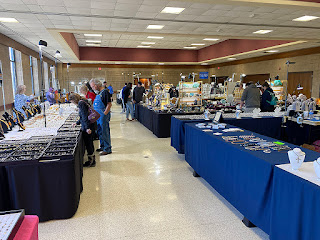
Every year the East Texas Gem & Mineral Society hosts their annual Gemstone & Jewelry Show.  Dealers from across Texas and beyond converge on the Tyler Rose Garden Center to sell custom jewelry, unique gem & mineral specimens, rare fossils and other treasures dug from the earth beneath our feet.  We've been to a few of the group's functions and was happy to return for this year's show.  

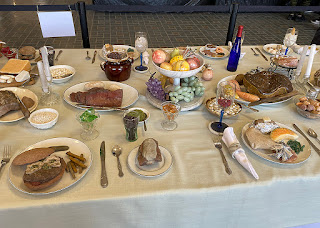
One of the show's best attractions is the Rock Food Table.  Take a close look at the picture above.  What looks like a delicious spread of fine dining choices are actually all rocks.  Most of the pieces are rocks that just happen to be shaped like certain foods but some of them are polished/finished to complete the illusion.  

The Rock Food Table is currently owned by a member of the ETGMS but originated by a couple in the Gulf Coast region.  A few years back we shot some footage of it for the documentary "RockHounds: The Movie."  Here's a clip:


Just for fun, we got some updated video on this visit for our TikTok.  Here's a quick look at the current Rock Food Table and maybe you can spot some new dishes on display:
@geologyvideo Rocks that look like food #geology #rocks #gemandmineralshow #science #rockfoodtable #earthscience #fyp ♬ Eat It - "Weird Al" Yankovic

Other attractions at the show included a silent auction, a fluorescent mineral display, door prizes, demonstrations and kids games.  We picked up a few new specimens for collection and got a look at some great displays that included petrified wood, lapidary work and other great pieces found by ETGMS club members.


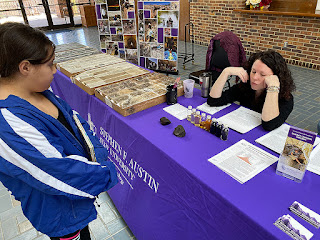
The Geology Department from Stephen F. Austin University was also represented at the show.  Professor Bloxson and one of her grad students were there with information about oil deposits in east Texas and the rocks in the area that contain the oil.  They had great information for young aspiring geologists and anyone else that might have an interest in the subject. 


Saturday, October 1, 2016

Natural Selection

We recently headed out to First Monday for multiple reasons:  it's one of the biggest flea markets in the world, some say it's the best and, most importantly, it's relatively close to where we live.  Let's see what we found!

So as we browsed the acres of booths we decided to show off what we saw and wanted to go with a theme.  Let's call it "Nature."  All our finds today either had to be dug up, skinned or otherwise liberated from mother nature.  Here's the Top 5 of what nature's bounty had to offer:

5. Skulls - Various Animals/Sizes


The best part here is the variety.  If you're in the market for the a small mammal skull then odds are you can find what you need at this booth.  What's your pleasure?  Muskrat skull?  Skunk skull?  With jaw?  No jaw?  One stop shopping.

4.  Barite Rose Rocks


The official state rocks of Oklahoma are so rare that they are almost only found in the Sooner State.  These aren't the best formed ones we've seen but their still pretty good.  The unique way they are formed makes them look like their namesake roses and the Oklahoma red dirt gives them their appropriate color.

3.  Bear Skin Rugs


So apparently bear skin rugs are a real thing.  They usually only exist in cartoons and 1970's cologne advertisements but it looks like they can also be found at First Monday.  Even though the usual cliche is to relax on one of these in front of a roaring fireplace, these guys seem a little too creepy to be relaxing.

2.  Big Honkin' Rock Slab Tables and Chairs


If you ever wanted to feel more like Fred Flintstone in the comfort of your own home then these beauties are for you.  Sure they're a little pricey and probably extraordinarily difficult to move but you can't deny how cool these things look.  Can't wait to see their rock slab recliner and loveseat.

 1.  Cobra Vertebrae Necklace


You may be "cool" but are you "Cobra Vertebra Necklace cool"?  Probably not.  Only a certain kind of person could pull off adorning themselves with the bones of a poisonous snake.  If you're not sure that's you then you can work your way up to it with the Cobra Vertebra Bracelet.

It was a great haul this time around.  We'll see what we get at the next flea market...


Sunday, April 17, 2016

Texas Education on iTunes U

Two of our podcasts, Geology Kitchen and East Texas Explorer were recently selected to be a part of Texas Education on iTunes U, a free multimedia content to educators, students, and parents in Texas and around the world from the Texas Education Agency!  You can find it on iTunes HERE.


Wednesday, March 23, 2016

Traveling the El Camino Real


Devin explores a portion of the the historical El Camino Real trail from western Louisiana to east Texas in this new video:


Wednesday, August 5, 2015

Sunday, February 22, 2015

Marking Time #33 - Camp Howze


If you drive from Texas to Oklahoma and back as much as we do, you will quickly notice that near the border, on the Texas side, are signs indicating a that there is a World War II monument in the area.   Which begs the question, "What part of World Wart II happened in North Texas?"  A little exploration led to this Historical Marker:

The marker reads:

     "In operation from 1942 to 1946, Camp Howze served as an infantry training facility during World War II. It was named for General Robert Lee Howze (1864-1926), a native Texan whose distinguished career in the United States Army began with his graduation from West Point and included service in France, Puerto Rico, Germany, a South Dakota Indian War and the Philippine Insurrection, 1899-1902. 
     Clifford McMahon of the Gainesville Chamber of Commerce first contacted Federal authorities with the idea of establishing a military installation here. Attracted by the community's active endorsement of the plan, the government activated Camp Howze on August 17, 1942, under the command of Colonel John P. Wheeler. In addition to infantry training, the base was also the site of a German prisoner of war camp and an air support command base, now part of the Gainesville Municipal Airport. Services provided for the soldiers included camp exchanges, libraries, chapels, theaters, service clubs and a base newspaper, the "Camp Howze Howitzer." 
     The economic and social impact of Camp Howze on Gainesville was significant and was instrumental in the town's rapid growth and development. (1982)"

So apparently in the 1940's, near Gainesville, TX,  the Army operated a Training Base/POW Camp.  But if you go to the location today all you see is an empty field behind an historical marker.  That's because the Army had always intended it to be a temporary facility.  The buildings were not made to last and after the war they were torn down.  Some concrete foundations can still be seen if anyone wants to look for them.

In a letter to his sweetheart (which can be read along with tons of other old letters on this great site), PVT. Prune R. Brooks mentioned the shoddiness of the buildings, helping to explain even more why there's nothing left of them today. 


He writes:

"11/28/44 

Dearest Donna,

Well honey here I am down in Camp Houze Texas and what a hell of a camp. The buildings are so old and so about to fall down. But the south is very beautiful and the girls are pretty as the devil. I stopped off in Fort Worth Sunday and went roller skating and met a few very nice girls and had lots of fun.

This will be a very short letter till the next. I haven't much time. Honey I want you to write often and please send your picture. I send you mine for Xmas. I will close for now and will compose soon again 

Love,
Verne"

But if you are in the mood to stop during your drive along I-35 to snap some pics of something historic, you can hit the Texas Travel Information Center in Gainesville (and take a much needed restroom break) to see the other historic World War II monument. 


Look behind the great big Texas photo op and you'll find the 103rd Infantry Division Monument.  Sculpted by artist Edd Hayes and titled "A Call to Duty," the monument pays homage to the 103rd who trained, in part, at Camp Howze. 


It's amazing what you can learn along the roadside. 


Thursday, February 19, 2015

Throwback Thursday - Wilds of Africa at the Dallas Zoo

We've been digging through the archives and found some pics and video from our shoot of the Dallas Zoo years ago.  We had previously posted our video from the Lacerte Family Children's Zoo at the Dallas Zoo in the past but now, for your viewing pleasure, is our video from the "Wilds of Africa" exhibit at the Dallas Zoo:


Saturday, November 8, 2014

Babe’s African Market in North Texas

A quick look at some of the food you can buy at Babe’s African Market in Bedford, TX:


Saturday, February 8, 2014

Marking Time #31 - Petrified Wood Gas Station

The Petrified Wood Gas Station holds a place in the pantheon of Texas roadside attractions.  It's got the triple threat pedigree that we are always on the lookout for:  Science, History and Culture.  We'll start, as we frequently do, with the historical marker:


     "Local businessman E. F. Boydston (1888-1945) purchased this site, a former feed lot, in 1927 for $400. Recognizing a potential business opportunity in offering services to the traveling public, he built a wooden shed and gas station in 1927. Travelers were allowed to build campfires during overnight stays, and by 1931 Boydston added three wooden cabins with garages to the camp complex. The buildings later were faced with rock, and more cabins and garages were added in 1935. The original wooden gas station was covered with petrified wood in 1935 when the highway was widened and remained in operation by the Boydston family until 1988.
     The Texas Lunchroom, a one-room frame building, was built in 1929. Renamed the Texas Cafe in 1935 and faced with stone to match other buildings in the complex, it was enlarged to provide second-floor living quarters. Popular with local high school and college students, as well as families and the traveling public, it was closed in the 1960s after a highway bypass built west of town diverted traffic from this area. The cafe reopened in 1993. One of the few intact examples of tourist camps built throughout Texas in the mid-20th century, this property is significant for its association with the early development of automobile tourism."

 And we move on, as we frequently do, to the video.  Devin explains the awesomeness of this location:


Friday, October 25, 2013

Inside the Green Dragon

A quick look at the refurbished trolley car known as the "Green Dragon," part of the McKinney Avenue Transit Authority's M-Line in Dallas, TX:


Tuesday, July 2, 2013

Geo-Walk: Enchanted Rock

Devin takes a walk around Enchanted Rock State Natural Area near Fredericksburg, TX and talks about some of the local geology:


Thursday, May 2, 2013

The Big Inch Pipeline

A quick look at the role of the East Texas Oil Field in World War II:

Wednesday, March 13, 2013

The Oil Boom of Ranger, TX

Here's a quick look at some history of the oil boom of Ranger, TX:

Friday, February 3, 2012

Marking Time #20 - Bergfeld Park

Another trip to Tyler means another excuse for a new "Marking Time." This time we'll stop by Bergfeld Park.

As you probably guessed, Bergfeld Park was named after someone called "Bergfeld." Rudolph Bergfeld, to be exact...and he not only did he get a park named after him but he got his very own historical marker:

The marker reads:

"Entrepreneur and property owner Rudolph Berfeld was a significant figure in the development of the city of Tyler. Bergfeld was born in Wisconsin and as a youth apprenticed at his uncle's jewelry business in Germany. He returned to the U.S. in 1874 and worked as a bookkeeper in St. Louis, Missouri. In 1878, Bergfeld moved to Tyler, where he opened a saloon. In 1880, he married Caroline "Lena" Pabst, moving into a house he built for her.
By the 1880s, Bergfeld opened a second saloon and began to work in real estate and railroad ventures. In 1887, he helped to open the Grande Opera House. By the 1890s, Bergfeld had turned his interest to banking, opening Bergfeld Loan & Trust, which merged with City National Bank to create Citizens National Bank in 1900. That same year, the newly created Tyler Chamber of Commerce appointed him Director. In 1901, he opened a second Bergfeld Loan & Trust, which in 1905 consolidated with Farmers & Merchants National Bank.
Bergfeld's real estate activities were also notable. He actively developed property throughout the city, including the historic Azalea District. Bergfeld also sold land to the city for use as a park, which was named in his honor.
Besides Bergfeld's positions on banking boards, he served as chair or director of several different companies and organizations. He was also a member of the Board of Education of Tyler Public Schools (1906-1924) and of fraternal organizations. Rudolph Bergfeld died in 1930 and was buried in Oakwood Cemetery. Today, he is remembered as a community leader whose business activities contributed greatly to the growth of Tyler. "

The park is full of neat stuff like this dolphin statue (that I assume is a fountain during warmer weather), a tennis court, an amphitheater that is frequented by the East Texas Symphony Orchestra and, of course, playground equipment:

And just like our last Tyler edition of "Marking Time," this place also has a double dose of historical markers:

This one recalls an old Confederate weapons factory that was near this location and reads:

Near Site of C.S.A
Ordnance Plant

"Founded 1862 by J.C. Short and WM. S.N. Biscoe (both gunsmiths) and Col. Geo. Yarbrough. In 2-story brick main building, on 125-acre site, contracted to make for state of Texas 5,000 rifles for the arming of troops in the Civil War. After trouble obtaining men and material, plant was sold in October 1863 to the Confederate government. Short and Biscoe stayed on with the plan to continue making guns.
With machinery and men evacuated from areas under siege in Arkansas operated under command of Lt. Col. G.H. Hill. Plant included leather shop, tin shop, dry kiln, carpenter shop. The 150 to 200 man workforce had (besides gunsmiths and guards) butchers, tanners, blacksmiths, draftsmen, carpenters, harness makers and coal burners. Guns made were .45 calibers long and short hill rifles, long and short Texas rifles, Austrian, Enfield and Tyler rifles with barrels 27 to 37 inches long. Some were equipped with steel tipped bayonets invented by Short during 3 months of 1864. Products made were 394,156 cartridges, 411 rifles and 3, canteens. 160 guns were repaired.
Many Tyler rifles were sent to troops fighting North and East of Red River to prevent federal invasion of Texas."